Historical Topic: Odds & Ends
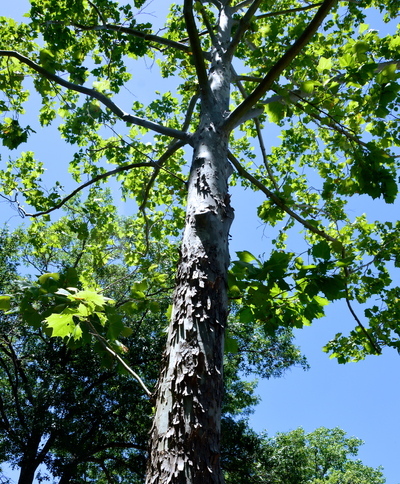
Species: Sycamore
County: Travis
Public Access: No longer applicable; tree is dead
If historic trees tell us of our past, this sycamore tree in Austin speaks for our future. Though young in age, it has already been on a remarkable journey. In early February 1971, Apollo 14 Command Module Pilot Stuart Roosa—a former Forest Service smoke jumper—carried hundreds of tree seeds in his personal gear while orbiting the moon. It was NASA’s third manned-landing on the moon, and the seeds were part of a joint NASA-United States Forest Service project initiated by Forest Service Chief Ed Cliff. Seeds from five different types of trees were selected—Douglas fir, loblolly pine, redwood, sycamore, and sweetgum. The Forest Service germinated the seeds after Apollo 14’s return to earth, and the seedlings—known as Moon Trees—were planted throughout the United States, often as part of the nation’s 1976 bicentennial celebrations. The trees were planted in various places, including historic sites and locations associated with the Apollo program. Several state capitol buildings, county courthouses, state parks, and elementary schools were also honored with Moon Trees.
But the one that rises above all others is the sycamore Stuart Roosa planted at his home with his family in 1978. Known today as the Austin Moon Tree, it is the only privately owned,
first-generation Moon Tree in Texas. His daughter Rosemary continues to perpetuate her father’s love of trees through The Moon Tree Foundation, which promotes the planting of second-generation Moon Trees around the world.
Today, approximately sixty-five Moon Trees grown directly from the Apollo 14 seeds are still living. There are likely hundreds of second-generation Moon Trees, but the exact number is unknown. Planetary Scientist and Archivist Dr. Dave Williams, of the NASA Goddard Space Flight Center, has been informally archiving Moon Trees for years, and now maintains an online record through the National Space Science Data Center.
The seeds, which circled the moon thirty-four times, were initially taken aboard Apollo to study the effects of prolonged weightlessness on seed germination and seedling growth. Two trees from identical seeds—a Moon Tree and a “control” tree that didn’t travel to the moon—were planted together at the Palustris Experimental Forest in Louisiana. No discernable difference between the two trees was ever detected. In fact, all of the Moon Trees grew normally. Now, more than forty years later, most would agree the value of the Moon Trees isn’t in the science, but in the history. “As someone pointed out, unless we send people back to the moon soon, the Moon Trees will end up being the only living things on earth that have been to the moon,” said Dr. Williams.
Stuart Roosa passed away in December of 1994, but the Moon Trees remain a living tribute to him and the Apollo program. The current owners of the Austin Moon Tree acknowledge the duty and honor of this legacy. “It is a huge responsibility to be the groundskeeper for such an important tree. I take great pride that the tree is on my property,” said owner Dennis Worsham. “It gives me hope for the future that we may be able to grow plants on distant planets as we continue to explore the great unknown. While the tree may not be part of the history of the Texas frontier, it is a unique and living example of [the] new frontier.”